Design for assembly
Footprint verification, component orientation, spacing, panelisation and process compatibility reviewed before the first build.
T · [CLIENT TO PROVIDE] E · [CLIENT TO PROVIDE]
Overview
Assembly introduces its own physics: solder paste behaviour, thermal profiles, component orientation, panelisation, moisture sensitivity and the tolerances of the process being used. A design that ignores them produces yields that look fine on ten boards and fail at a thousand.
We engineer the assembled board as the real deliverable. Footprints are verified, paste and mask decisions are deliberate, component packages are chosen with the assembly process in mind, and test access is planned alongside the circuit.
Prototype assemblies are then validated methodically — power-up sequence, functional checks, measurement against expected behaviour — so the results are evidence rather than impressions.
Assembly engineering
Work that sits between a finished layout and a board you can build repeatedly.
Footprint verification, component orientation, spacing, panelisation and process compatibility reviewed before the first build.
A BOM that is buildable: verified part numbers, alternates where possible, lifecycle status and clear notes on anything critical.
Integration of modules, connectors, sensors and mechanical interfaces so the assembled board fits the product it belongs to.
Coordination of prototype builds, first-article review and structured feedback into the design before volumes increase.
Powered bring-up, functional verification and measurement of the assembled board against the intended behaviour.
Assembly documentation, test strategy, build notes and the data package a manufacturer needs for a repeatable process.
A design that ignores the assembly process produces yields that look fine on ten boards and fail at a thousand.
On design for assembly
Assembly introduces its own physics: paste behaviour, thermal profiles, component orientation and the tolerances of the process actually being used.
Build process
Each stage exists to remove a category of build surprise.
Layout reviewed specifically for assembly: footprints, clearances, orientation, thermal relief and process fit.
Parts verified, lifecycle checked, alternates identified and procurement risk flagged before the build is committed.
Prototype build arranged with the chosen manufacturer, including the notes and clarifications that prevent avoidable errors.
The first assembled boards inspected against the design intent, with findings recorded and fed back.
Structured power-up and functional testing, with measurements compared to expected values rather than eyeballed.
Findings turned into design or documentation updates so the next build is better than the last.
Assembly documentation and test strategy finalised for repeatable builds.
Validation
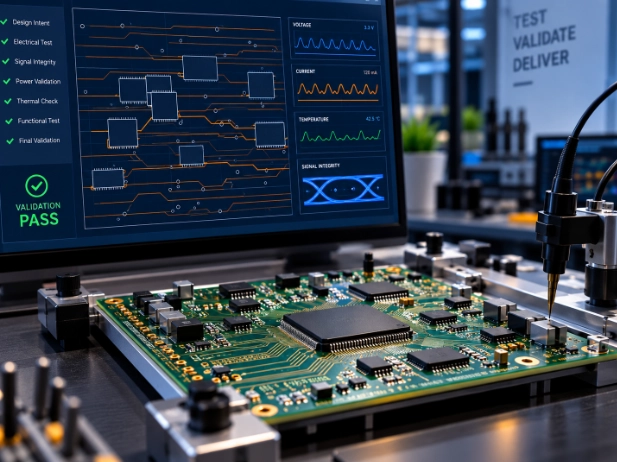
A built board is validated when its behaviour has been measured against the design intent and the result written down — not when it powers up without smoke.
Power-up sequence, functional checks and measurement against expected values are run in a defined order, and the findings feed back into the design before volume increases.
Applications
Assembly engineering pays for itself wherever build quantity, board complexity or reliability expectations are meaningful.
Related
We can review the design for assembly, prepare the build package and validate the first units.
Stack-up, placement, routing and integrity.
Open → 02Architecture, circuits and board-level design.
Open → 03DFM, supplier and build coordination.
Open → 04Documentation, tooling and build packs.
Open → 05Functional and reliability testing of built units.
Open →FAQ
Common questions about the step between layout and a working assembled board.
We provide PCBA engineering, build coordination and validation. Details of in-house assembly capability are to be confirmed by the company; where assembly is carried out by a manufacturing partner, we prepare the data package and support the build.
By reviewing the layout specifically for assembly before release, verifying footprints against real components, preparing an unambiguous BOM and agreeing a test strategy before the first build rather than after it.
Yes. That usually starts with reviewing the design, the build documentation and the failure evidence, then measuring assembled units to separate design causes from process causes.
That depends on the board and the volume. Options range from functional test against a defined sequence through to fixtures with structured coverage. We agree the approach while the board can still be changed to support it.
Next step
Tell us what the product has to do and we will tell you what engineering it needs.