Compact multilayer boards
Dense layouts where placement, stack-up and thermal spread are decided together.
T · [CLIENT TO PROVIDE] E · [CLIENT TO PROVIDE]
Consumer products rarely fail on one requirement. They fail on the combination.
Sector challenge
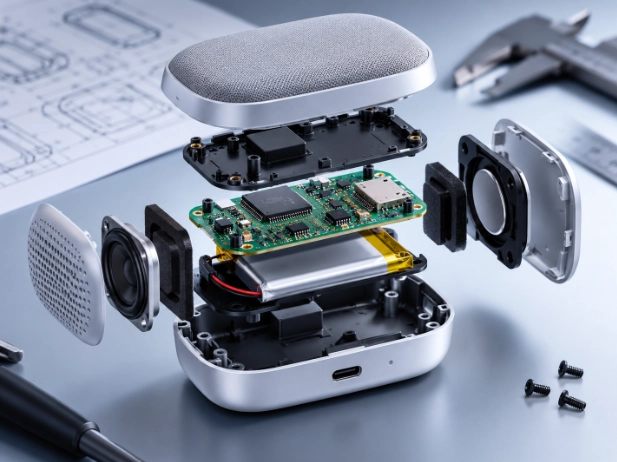
Consumer electronics rarely fail on any single requirement. They fail on the combination: the board has to fit a shrinking enclosure, run from a small battery, hit a unit cost that leaves margin, and still deliver a product that feels responsive and reliable.
Each of those constraints improves at the expense of the others. Reducing size raises thermal density; cutting cost removes margin; extending battery life limits processing. The engineering value is in finding the arrangement where all four are acceptable.
Volume magnifies everything. A decision that costs a small amount per unit or lowers yield slightly becomes significant across a production run, so manufacturability is a design input from the first sketch.
Electronic systems
Density, cost and battery life are decided together or not at all.
Dense layouts where placement, stack-up and thermal spread are decided together.
Power path, charging and protection electronics with measured consumption per operating state.
Antenna placement, matching and coexistence handled as part of the board design.
Interface hardware engineered for responsiveness and manufacturing consistency.
Sensing engineered for accuracy in a small, thermally active and electrically busy space.
Assembly, test and yield considered from the first placement decision.
Constraints
| Constraint | Why it matters here | How it is addressed |
|---|---|---|
| Enclosure space | Mechanical design and electronics compete for the same volume | Early mechanical alignment and placement zoning before routing |
| Battery life | Marketing targets rarely survive real firmware | Measured current per operating state, tracked as a live budget |
| Unit cost | Small per-unit decisions dominate at volume | Cost modelled at architecture stage with margin placed deliberately |
| Manufacturing yield | Small yield losses become large at scale | Design for assembly review and test strategy agreed before layout freeze |
Volume
At volume, assembly process, test time and yield move unit cost more than component prices do — and all three are decided long before the layout is finished.
Design for assembly is therefore an architecture-stage activity here, not a review before release.
Applications
Typical products
Engineering emphasis
Capabilities
The disciplines below carry most of the work in this field.
Applied to this sector.
Open → 02Applied to this sector.
Open → 03Applied to this sector.
Open → 04Applied to this sector.
Open → 05Applied to this sector.
Open → 06Applied to this sector.
Open →From the architecture stage. At volume, assembly process, test time and yield have more impact on cost than component prices, and they are decided by choices made long before the layout is finished.
We treat the power budget as a tracked requirement with measured current in each operating state. If the target is not achievable with the chosen architecture, that becomes clear early rather than at validation.
We design with regulatory requirements in mind and prepare products for testing. Accredited certification is performed by qualified laboratories; our compliance support scope is to be confirmed: [CLIENT TO PROVIDE].
Related
The engineering discipline transfers; the constraints do not.
Industrial equipment runs continuously, in electrically noisy environments, of…
Open →02Automation asks electronics to do two things at once: hold a deterministic con…
Open →03Healthcare electronics are judged on accuracy, repeatability and the ability t…
Open →04Vehicle electronics face wide temperature ranges, electrical transients, vibra…
Open →05Connected products are easy to demonstrate and hard to sustain. The engineerin…
Open →Next step
Tell us what the product has to do and we will tell you what engineering it needs.