A Linux device is a system, not a distribution.
Overview
A Linux device is a system, not a distribution
Choosing Linux for a product is a systems decision. It brings drivers, networking, filesystems and tooling, and in exchange it asks for a boot chain that works every time, a kernel configured for the hardware, a reproducible build and a way to update devices safely in the field.
We engineer that whole chain: bootloader configuration, device tree, kernel and driver work for the board as designed, a userspace containing what the product needs and nothing else, and a build system that produces the same image twice.
Startup time, storage wear, power behaviour and recovery from a failed update are treated as product requirements, because for an embedded device they are.
Linux scope
What embedded Linux engineering covers
From the first instruction after reset to a maintainable image you can ship.
-
Board support
Bootloader configuration, device tree development and kernel setup for the board as actually designed, not a reference variant of it.
-
Kernel and drivers
Driver development and kernel-side integration for peripherals that have no usable upstream support.
-
Build systems
Reproducible image builds with a defined package set, version pinning and a pipeline your team can run without tribal knowledge.
-
Userspace applications
Application services, init and supervision strategy, logging and the interfaces the product exposes.
-
Update strategy
Image or package update mechanisms with integrity verification, rollback and a defined behaviour for a power loss mid-update.
-
System hardening
Reduced attack surface, sensible service and permission configuration, read-only filesystems where appropriate and credential handling.
Platform process
Bringing a Linux platform up on new hardware
Ordered so that each layer is proven before the next one depends on it.
-
Platform assessment
SoC, memory, storage, peripherals and boot media reviewed against what the product has to do and how fast it must start.
-
Boot chain
Bootloader configured and verified, including boot media, failure behaviour and the recovery path.
-
Kernel and device tree
Kernel configured for the hardware, device tree written for the board and peripherals verified individually.
-
Driver work
Drivers developed or adapted where upstream support is missing or does not match the hardware as built.
-
Build pipeline
Reproducible image build established with pinned versions and documented build instructions.
-
Userspace and services
Application services, supervision, logging and interfaces implemented and tested on target.
-
Update and maintenance
Update mechanism implemented and exercised, including interrupted updates and rollback.
Lifecycle
Reproducible today, buildable in three years
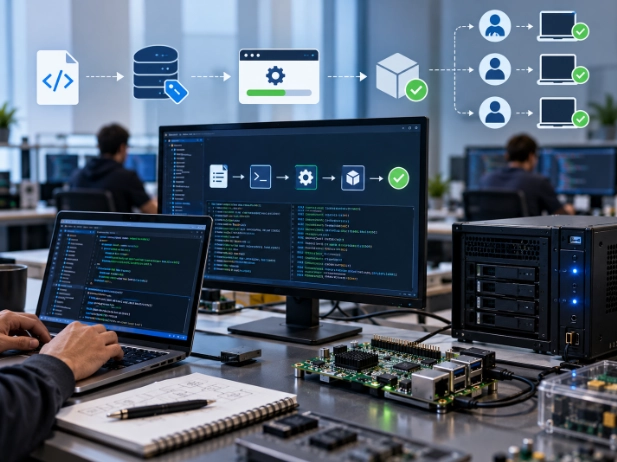
An image that only one machine can build is a liability. Pinned versions, a documented pipeline and a build anyone on the team can run are what make a Linux product maintainable.
The update path is engineered with the same seriousness: verified, interruptible and recoverable.
Applications
Where embedded Linux fits
Where Linux fits
- Gateways and edge devices handling networking and data
- Products with graphical or web-based interfaces
- Devices performing substantial local data processing
- Equipment integrating multiple communication interfaces
- Platforms shared across a family of related products
- Existing Linux products needing kernel, security or lifecycle updates
Platform work
- Bootloaders
- Kernel configuration
- Device tree
- Driver development
- Build systems
- OTA update
- Hardening
FAQ
Embedded Linux questions
What usually determines whether Linux is the right platform for a product.
When the product needs hard real-time determinism, very fast startup, minimal power draw or very low unit cost. In those cases a microcontroller with an RTOS or bare-metal firmware is usually the better engineering answer.
That is the usual starting point. Board support work — bootloader, device tree, kernel configuration and peripheral drivers — is what makes a custom board behave like a supported platform.
With an update mechanism designed for the storage layout and the risk profile: integrity verification, atomic switching where the storage allows it, rollback on failure and defined behaviour if power is lost mid-update.
Maintainability is designed in through reproducible builds, pinned versions and documentation. Ongoing maintenance and security update arrangements are agreed per project.
Next step
Custom board that needs a Linux platform it can ship on?
Tell us the SoC, the peripherals and the startup and update requirements. We will scope the board support work.