Sensor integration
Sensing front ends engineered for accuracy, calibration and stability under the conditions the device will actually see.
T · [CLIENT TO PROVIDE] E · [CLIENT TO PROVIDE]
Overview
Adding a radio to a product does not make it a connected product. The device has to acquire meaningful data, decide what is worth sending, survive intermittent connectivity, manage its power budget and remain updatable for years after it ships.
We engineer the whole chain: the sensing front end, the processing that turns raw measurement into useful data, the connectivity choice, the behaviour when the link fails, and the mechanisms that let a fleet be provisioned, monitored and updated.
Connectivity technology is selected against the deployment: range, power, data volume, infrastructure, regulatory context and expected service life. The right answer for a mains-powered gateway is rarely the right answer for a battery sensor.
Connected scope
The engineering between a sensor reading and a useful, trustworthy data point.
Sensing front ends engineered for accuracy, calibration and stability under the conditions the device will actually see.
Wired and wireless technology selected and implemented against range, power, data volume and deployment reality.
Sampling, buffering, compression and transmission strategy that respects both the power budget and the value of the data.
Local processing so decisions that need to be immediate stay on the device and only meaningful data is transmitted.
Device health, status and diagnostics exposed so a deployed fleet can be understood without a site visit.
Provisioning, credential handling, transport protection and update integrity designed in proportion to the deployment risk.
Connected process
The deployment environment drives the technical decisions, not the other way around.
Where devices live, what power they have, what network exists, how many there are and how long they must last.
What is measured, at what rate and accuracy, what must be sent and what can be decided locally.
Technology chosen against range, power, throughput, infrastructure, cost and lifecycle support.
Hardware, firmware and connectivity built as one system with the power budget tracked throughout.
Provisioning, identity, configuration, monitoring and update behaviour designed for scale rather than one unit.
Behaviour verified under real conditions, including poor signal, connection loss and recovery.
Intelligent electronics
Not every decision should travel to a server and back. Where latency, bandwidth, cost or reliability say otherwise, the device decides for itself.
Filtering, aggregation and analysis performed on the device so only meaningful data leaves it.
Local decisions driven by measured conditions, with thresholds and behaviour defined by the application.
Bounded processing within the timing and memory budget the platform actually has.
Deployment
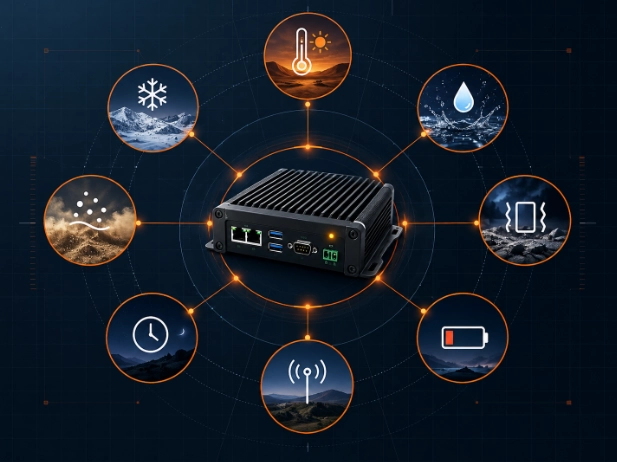
A connected product is not judged on the demonstration. It is judged at the edge of coverage, on a depleting battery, eighteen months in, with nobody there to restart it.
So those conditions are designed for and tested deliberately, rather than discovered after installation.
Applications
From single-purpose sensors to gateways handling many devices at once.
It depends on range, data volume, power source, the infrastructure at the deployment site, unit cost and how long the technology needs to remain supported. We evaluate the options against your deployment rather than starting from a preferred technology.
By treating the power budget as a tracked requirement: measuring current in every operating state, minimising radio activity, choosing components for sleep behaviour and validating consumption on real hardware rather than from datasheets.
Our focus is the device and its data path. We implement the device side of the integration and work to your platform or API. Cloud platform scope is agreed per project: [CLIENT TO PROVIDE].
Proportionally and practically: secure provisioning, credential handling, protected transport, signed updates and a reduced interface surface. Formal security certification scope is not claimed unless independently confirmed.
That behaviour is specified up front — local operation, buffering, retry strategy and recovery on reconnect — and tested deliberately, because it is a normal operating state rather than an exception.
Tell us where the devices go, what powers them and what data matters. We will map the engineering.